Versions
While the first edition came together, I started telling people what I was doing and how much fun I was having. Family and friends were very encouraging, and some generously offered to read drafts.
Finishing my first draft came with a huge sense of accomplishment and a false sense of completion, the latter of which faded quickly. I soon realized there was so much more I wanted to add to the book!
I started to make a project plan for the steps I wanted to take along the way, including which friends and family members I wanted to read which version. I knew I didn’t want to ask the same people to read each draft because it may be difficult to parse all of the fine differences with the major ones. The book ultimately had four main drafts, and I had four distinct pre-reading cohorts.
With each cohort I clearly outlined the kind of feedback I was looking for, asking them two main questions:
1. Are you having fun?
2. Does it make sense?
Since I liked creating the “puzzle” of my mystery, I didn’t want suggestions for improvement, but I did want to know where things weren’t working so I could improve them. I also wanted to know if the book was fun and kept their attention.
My first readers were happy to do so, and gave me great critiques to work with. For example, they told me I had too many characters, which led me to combining, deleting, and anonymizing various characters.
In retrospect, I realize I had had an unhelpful habit that carried me through my first draft: Every time I sat down to write, I would start from the beginning and read everything I had written so far, make edits, and add more to the end. This gave me a sense of momentum, but it also meant that the first draft of the first half of my book was in great shape while the second half was rushed. Note to self: The next time I write a book, I will stick with reading only the preceding chapter when I am ready to write a new one.
I also should have taken more breaks in between drafts. Often, by the time I got feedback from a cohort, I'd already started making serious changes. Putting the manuscript down for a while and letting it marinate is better than relentlessly editing from the top down.
One of my more valuable discoveries was that reading printed versions of the book helped me find edits better than simply reading digital copies.
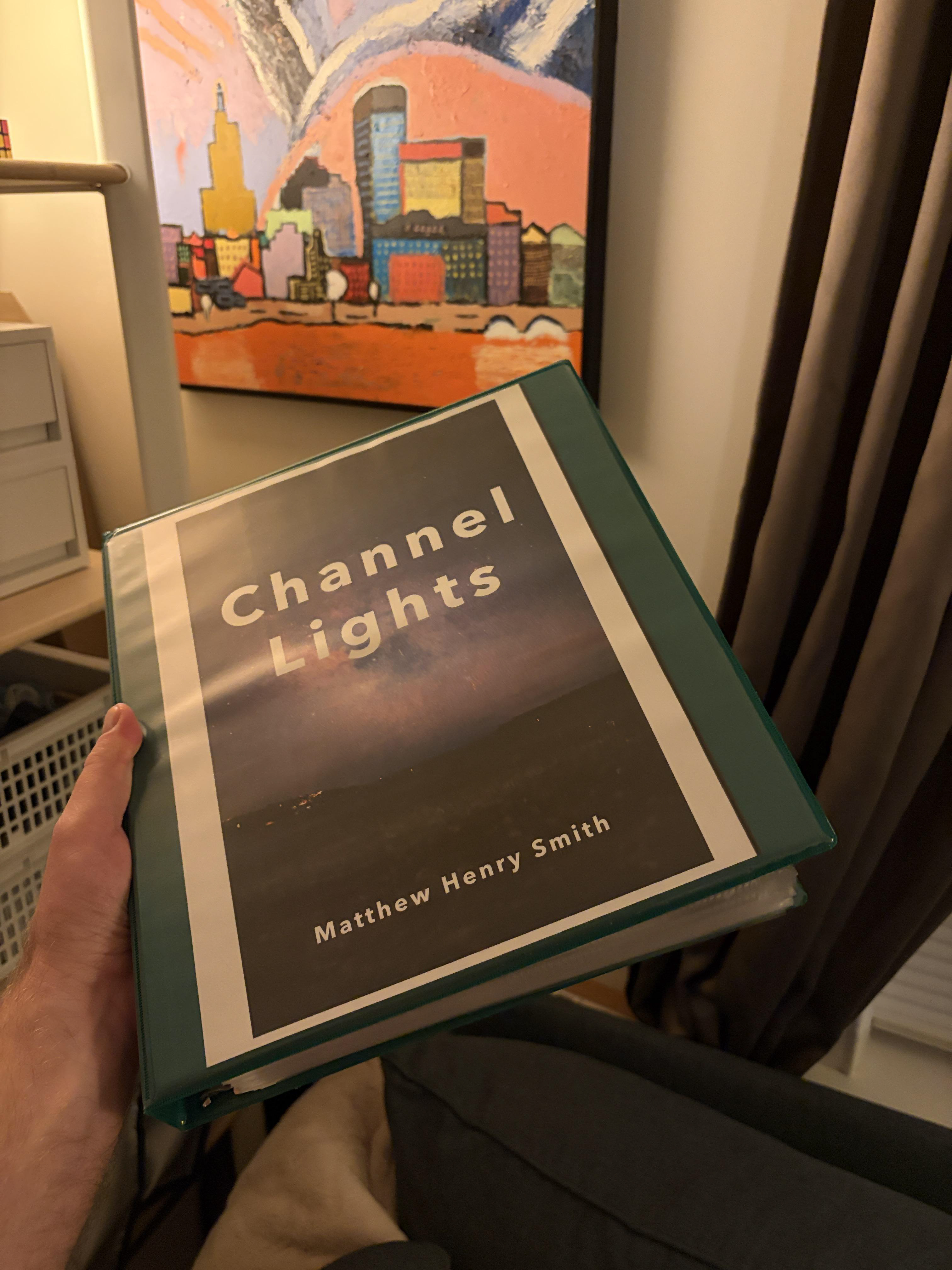
An early prototype of my book.
To Bare is Human
Regarding artificial intelligence, I want to be very clear that I wrote this book to express something. AI cannot express anything because ideas have no meaning to machines, only statistical significance.
No part of this book—not the text, the editing, or the cover illustrations—was artificially generated by language or design models. I never prompted a model to “write me a romantic mystery set in Rhode Island” or “make this scene even steamier” because the responses would have been meaningless thereby making the book meaningless, too.
That said, even works of fiction require some amount of research, and search engines are now powered by AI. So when a writer asks a search engine “what year did XX hurricane happen” or “what books explore themes of found family,” I think we’d be setting an impossibly high literary standard to exclude such queries from their creative process.
That would be like saying a photographer didn’t really take a picture because their camera used AI to set the right distance to autofocus the lens. There’s a clear difference between getting your focus right and asking Adobe to generate you a brand new image.
Some people are firmly anti-AI, and understandably so. But artificial intelligence is a term for a broad set of technologies that use data and predictions to guess a best result, and different versions of AI had been embedded in the tech we use every day long before Claude first appeared. We need to be able to differentiate between the applications of AI and how they are used.
As long as these tools are not generating or editing the work, we should be able to say that work is the result of genuine human intelligence.
In short, although AI is now an inevitable part of using what were formerly search engines and an arguably helpful tool for indexing information, it is insufficient.
Setting Goals
Throughout the processes of drafting and sharing versions of my manuscript, I considered what might be next. From my vantage point, there appeared to be three options:
1. Treat this as a successful learning exercise but shelve the book and perhaps write something totally different to continue honing my craft
2. Independently publish the book with online self-publishing tools
3. Traditionally publish the book through an agent and established publishing house
Option one didn’t seem quite right. I really loved the story, wanted more people to read it, and thought there was more to learn from somehow bringing it to the literary marketplace.
So I began to research options two and three, and developed these lists of pros and cons for each method.
Traditional Publishing
Pro: Can be helpful with physical distribution and usually has the industry connections to get a book into the hands of more readers
Pro: Typically owns or supports the process of readying a book for the market, complete with editing, cover design and marketing
Pro: Can help to legitimize a story in the eyes of readers and may provide a feeling of satisfaction of being chosen by tastemakers
Con: This process can be very slow, taking years or in some cases not working out at all. It usually begins with getting representation by an agent, which itself can also be time-consuming.
Con: While traditional publishers can help with marketing, they may expect a more consistent schedule of marketing engagement (events, signings, posts, etc.).
Con: Traditional publishers often have the final say over copy, marketing strategy, and other aspects of the product.
Independent Publishing
Pro: The freedom for the author to have final say over the copy and go-to-market strategy.
Pro: The ability to move as quickly (or slowly) as the author would like.
Pro: The flexibility to devote as much or as little time to the project as the author would like.
Con: Some will see this as the less “respectable” path. Several people told me to only view self publishing as a last resort.
Con: The author will need to cover the costs associated with editing, creating the cover, and going to market.
Con: The author may have a much smaller reach and struggle to gain physical distribution.
Regardless of which method I chose, I knew I wanted my manuscript to be in the best shape possible. Even if I pursued an agent’s representation, I wanted to use a visual to help sell the story. So I sought the services of both an editor and a cover illustrator.
This guide is not provided as legal guidance or financial advice.