About This Guide
This guide is a glimpse into my experience writing a novel for the first time.
Over roughly one year, I achieved my goals of:
1. Completing the manuscript
2. Selling over a hundred copies
3. Unlocking modest physical distribution
4. Learning about myself
5. Having a lot of fun
If these goals align reasonably with yours, this may help you build your own project plan for publishing. This guide is not provided as legal guidance or financial advice.
Getting Started
I began writing Channel Lights without any substantial concept of the story.
It was 2025. My favorite television shows weren’t resonating with me anymore. Artificial intelligence was being pitched as a solution to the “inefficiency” of creativity. Yet the things whose very purpose was to instantly satisfy could no longer do so.
So I began reading books again, an activity that necessarily takes time, patience, and delayed gratification. My attention span wasn’t attuned to it at first, but it gradually improved as I started turning pages and those pages became chapters.
Some stories, like The Wedding People and The Sea of Tranquility, gripped me in ways I’d forgotten books could. Others less so. Between these extremes, I started to see the faint outline of a question: Could I write something at least as good as the worst book in the bookstore? Perhaps I couldn’t write a celebrated bestseller but…
So I made a commitment to myself to write for fun. And I’d use the attention span I’d regained from reading to attempt a long-form project to craft a chapter book of my own.
I had the will and the focus; all I needed was the story.
Developing the Story
In the mornings and evenings, when I’d previously opened my computer to escape into streaming, I began to escape into my own mind. Just as I had rebuilt my attention span, I also began to rebuild my imagination.
This was a meditative process that started quietly, uncertainly, as I closed my eyes and asked myself what I wanted. Where would I go…if I could go anywhere...if I wanted to really feel something...if I was looking for adventure around every corner?
Block Island. I had been lucky enough to go there many times as a child with my family. And since I have an almost photographic topographical memory, it's very easy for me to visualize places I have been in great detail. Block Island was no exception.
As I would eventually write in Channel Lights:
Block Island, shaped like a half-empty teardrop, is a secluded resort town off the coast of the smallest state in the Union, one last stop in the sea before the vast expanse of the Atlantic truly begins. Not dissimilar to Nantucket or Cape Cod—though somewhat more remote—it is a cherished warm-weather playground for New Englanders. Out there, hydrangeas and honeysuckle fill the air with color and sweetness. Country roads twist back on themselves. Calamari sizzles. Families forget what they’ve left behind on the mainland. It is truly the home of summer.
But what kind of adventure should happen there?

A photo I took of the Block Island North Light in 2016.
A Very Personal Connection
Around the same time in my childhood that I’d go over to the island, I also loved adventure and mystery stories like The Goonies, Atlantis, MacGyver, and Murder She Wrote. But something was always missing that prevented me from fully connecting with these stories. To the degree they featured a romance storyline, I always found them inaccessible for reasons I’d later learn had to do with my sexual orientation.
Could I create my own mysterious adventure story that centers queer love?
I began to dive into my memories to write down what those summer days had been like, and gave myself permission to make changes like creating a hotel on the island where a murder might take place and characters who might have a reason for being there. I set the stage, invited the players, and began mentally simulating how they could become meaningful to each other.
I was creating a world where unbelievable things could happen. The points of entry into that world were my experiences on the island and ever since. I like to think about it like the titular wardrobe in C.S. Lewis’ The Lion, the Witch and the Wardrobe. The wardrobe is something from the real world that acts as a portal to the fantastical world, and is itself a part of that fantastical world tucked within its snowy, magical pine trees.
Facing my fear of flying with my husband in a frightening little Cessna on Cape Cod could be the wardrobe into the main character’s experience facing the same fears (and so much more) with his love interest on Block Island. My knowledge of photography could be a wardrobe into the mystery itself, where images capture more than they appear to and send the characters scrambling for buried treasure.
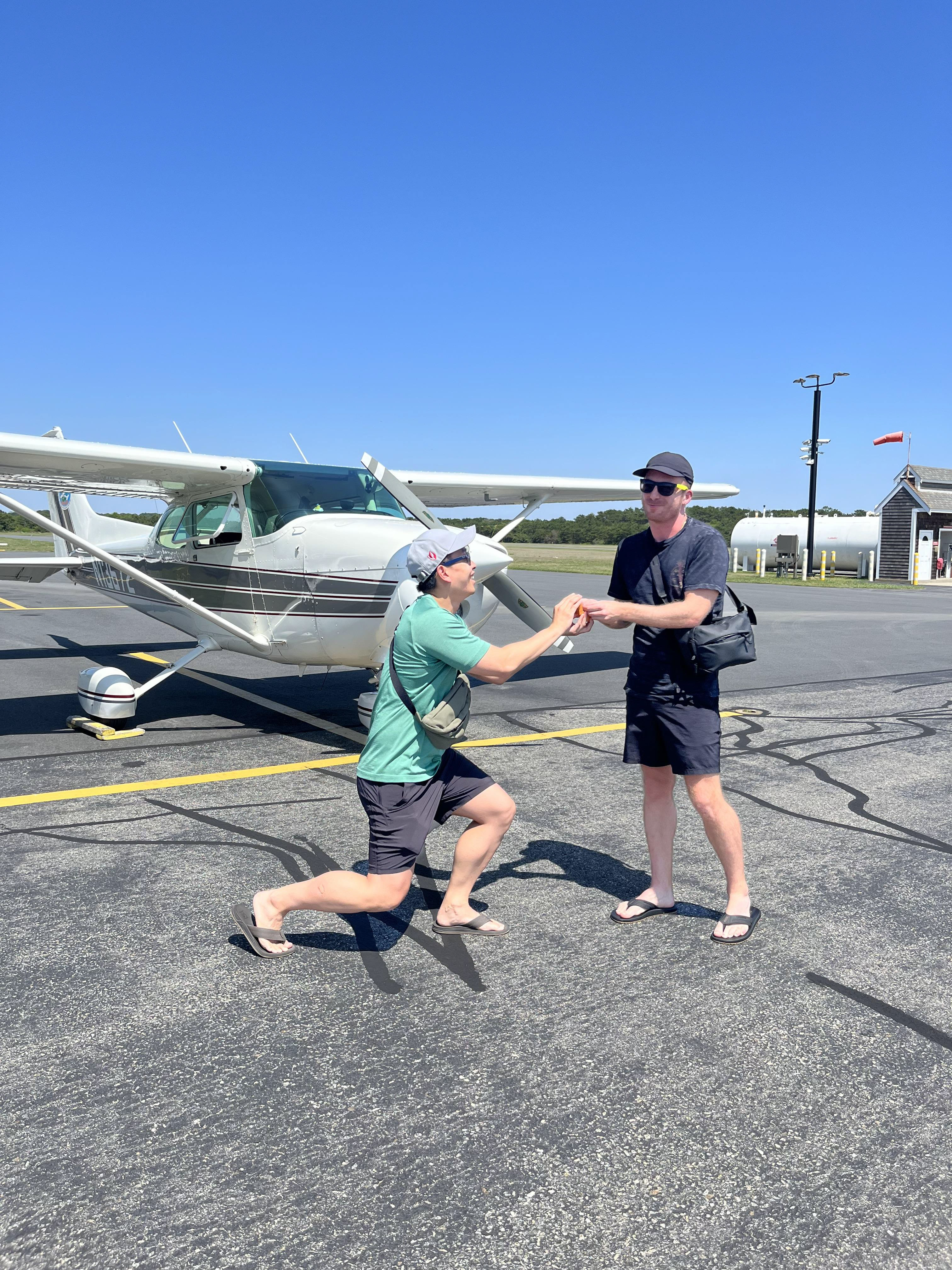
My husband proposing to me after I beat my fear of flying in a propeller plane.
I could enter the stage I had created through these wardrobes and set it for a story I’d wanted to see all my life.
By this point, I had momentum and began writing everything down, even if it was out of sequence or didn’t make sense. I kept digital and physical notepads available at all times to jot down ideas, and would spend several hours each day refining and organizing the fragments. By using tools like Google Docs and Apple Notes, I was able to write from anywhere which helped me ensure I never wasted inspiration. Across that year I recall writing different parts of the book during our family trips to San Francisco, Seattle, Vietnam, Paris and Halifax.
As the chapters came together, I even started to notice I had my own style: it moves quickly, with a tangible sense of place that reads almost like a script with stage directions.
This guide is not provided as legal guidance or financial advice.